Not every emergency gives your loved one time to find a button. Sometimes the hands that need to press it are the ones that no longer cooperate.
A voice-activated medical alert is a medical alert system that lets the wearer call for help by speaking a command or phrase instead of pressing a button. The spoken request reaches a 24/7 monitoring center, the same way a button press would. For an older adult with arthritis, Parkinson’s, or hands that shake when they are frightened, that difference can decide whether help arrives.
This guide walks through who voice activation is built for, how it works on a watch, and one limitation you should plan around before you buy.
Key takeaways
- A voice-activated medical alert lets a wearer call a 24/7 monitoring center by speaking a command instead of pressing a button.
- Voice activation helps older adults with arthritis, Parkinson’s, or post-fall shock who cannot reliably press a small emergency button.
- Voice activation fails when a wearer is unconscious, so automatic fall detection sends an alert without any speech or button press.
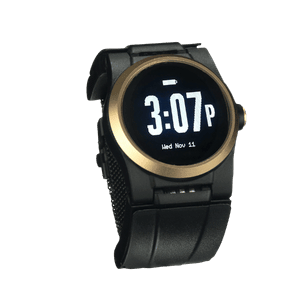
- The Kanega Watch reaches help three ways: by voice command, by button press, and through RealFall automatic fall detection.
- Two-way talk connects the wearer to a trained monitoring center responder who can contact family and dispatch emergency services.
- The Kanega Watch uses swappable batteries in the band, so the wearer charges spares instead of removing the watch.
- No medical alert system detects every fall, so voice and fall detection work alongside home safety changes and regular check-ins.
The Conditions That Make Pressing a Button Impossible
A help button assumes two things: that your loved one can find it, and that their fingers will do what their brain asks. For many older adults, neither is a safe assumption.
Arthritis and limited dexterity
Arthritis stiffens and swells the joints in the hand. On a bad day, gripping a pendant or pressing a small recessed button takes effort that an emergency does not allow. UnaliWear’s medical alert buyer guide notes that voice activation is especially valuable for older adults with diminished fine motor skills, including those living with arthritis. Speaking a phrase asks nothing of the joints.
Parkinson’s disease and tremor
Parkinson’s brings tremor and slowed movement. A hand that trembles can struggle to land on a button or hold it down long enough to register. The same buyer guide names Parkinson’s directly as a condition where calling for help by voice may be faster than pressing anything.
Post-fall shock
Even an older adult with steady hands can freeze after a fall. The body floods with adrenaline, the head spins, and fine movements get harder right when they matter most. If the pendant slid across the floor or the button is pinned underneath them, their voice may be the only thing still in reach.
There is also the long lie to consider. Geriatricians use that term for the time someone spends on the floor unable to get up before help arrives, and every minute on the floor raises the risk of a longer recovery. A wearer who can simply say a phrase shortens that wait, even when reaching anything with their hands is out of the question.
Memory loss and dementia
For someone living with dementia, a button can stop being a button. The muscle memory of “press this when you need help” may not hold under stress. A spoken phrase tied to a familiar routine is sometimes easier to recall, though no system fully solves the challenges that memory loss brings.
How the Kanega Watch Lets You Call for Help With Just Your Voice
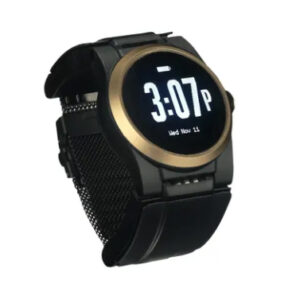
The Kanega Watch is a medical alert watch that connects to a 24/7 monitoring center. It lets your loved one reach help three ways: by voice, by button, and through automatic fall detection. The voice path is the one that asks the least of them physically.
Speak, and the watch listens
When your loved one needs help, they speak to the watch. There is no phone to find, no app to open, no pendant to fumble for. The watch carries its own cellular connection, so it works at home and on a walk around the block without a paired smartphone.
The watch then opens two-way talk with a trained responder at the monitoring center. Two-way talk means your loved one can speak with a real person through the device itself, describe what happened, and stay on the line until help is organized. They are not alone with a beeping gadget. They are talking to someone.
The responder can also reach you. If your loved one wants family called before an ambulance, or wants both, the monitoring center works from the instructions already on file. That is the part a direct-to-911 call cannot offer: a person who knows who your loved one is, where they live, and what they asked for ahead of time.
Built for the routine, not the manual
UnaliWear asks every new wearer to complete a short Emergency Readiness Call after the watch arrives. In about 20 minutes, a team member walks your loved one through calling for help and canceling a false alarm, so the first time they use the voice command is not during a real emergency.
That practice matters more than any spec sheet. A feature your loved one has rehearsed once, calmly, is a feature they can use when they are frightened.
Why Having Both Voice Activation and RealFall™ Automatic Detection Means Two Ways Help Always Finds You
Voice activation has one honest limitation, and any guide worth trusting will say it plainly: voice cannot help your loved one if they cannot speak.
A fall that knocks someone unconscious, a stroke, or a cardiac event can leave a person unable to call out at all. In those moments, a system that waits for a command waits forever. This is why the most reliable protection does not rely on voice alone.
What automatic fall detection adds
Automatic fall detection uses motion sensors to recognize the movement pattern of a fall and send an alert on its own, without a button press or a spoken word. This is critical in the case of a heart attack, stroke, or a fall that leaves someone unconscious.
The Kanega Watch includes RealFall™, UnaliWear’s fall detection technology. Most fall algorithms learn from staged drops in a lab. RealFall™ was trained on actual falls from real Kanega Watch wearers, so it recognizes how older adults move in everyday life.
Two paths to the same monitoring center
Picture the two paths together. Your loved one slips getting out of the shower but stays conscious, so they speak and reach a responder in seconds. Or they faint and hit the floor, and RealFall™ sends the alert because they cannot. Either way, the call lands at the same monitoring center.
Voice when they can speak. Automatic detection when they cannot. That is two ways help finds your loved one, instead of one.
Most voice-activated systems on the market do one job: they let the user alert the monitoring center by speaking. Pairing voice with automatic fall detection closes the gap that voice alone leaves open.
A note on accuracy: No fall detection system catches every fall, and no medical alert guarantees a response to every incident. Treat voice and fall detection as two strong safety layers, not a promise. Regular check-ins and home safety changes still matter.
What to Look For in a Voice-Activated Medical Alert System
Voice activation is not necessary for everyone. For an older adult with dexterity challenges, or a family worried about a nighttime fall when the pendant is on the nightstand, it is worth understanding before you buy. Use these questions to compare your options.
- Does it pair voice with automatic fall detection? Voice alone leaves a gap when your loved one cannot speak. Confirm the system offers both.
- Does it connect to a monitored center or just call 911? A staffed monitoring center has trained responders who can assess the situation, reach family, and dispatch help with your loved one’s information on file. A direct-to-911 device skips that layer.
- Does it work without a smartphone? A device with its own cellular connection protects your loved one whether or not a phone is nearby or charged.
- Will they actually wear it? A medical alert only works when it is on the body. A watch your loved one likes often gets worn more consistently than a pendant they hide under a collar.
- How does it handle charging? Every hour on a charging dock is an hour without protection. Ask whether the device needs a nightly charge or uses swappable batteries so your loved one stays covered.
On that last point, the Kanega Watch uses swappable batteries in the band. When the batteries run low, the wearer swaps in charged batteries and never removes the watch to charge it. For a parent who refuses anything that needs a nightly dock, that removes a common reason devices end up in a drawer.
Falls are the leading cause of injury among adults 65 and older, according to the Centers for Disease Control and Prevention. When a fall happens at home with no one close enough to hear, a device that answers a spoken command or a detected fall becomes the fastest way to reach help. Pairing it with a few home safety changes does even more; our checklist to help prevent falls covers the simple fixes that lower the odds of a fall in the first place.
Choosing a medical alert system can feel like one more task on an already full plate, and you are allowed to move at your own pace. Include your loved one in the decision when you can. A watch they help choose is a watch they are more likely to wear. As we wrote in Empowering Independence, the goal of this technology is to protect freedom rather than fence it in.
If you want to talk through whether voice activation fits your loved one’s needs, with no high-pressure sales, call 888-343-1513 or email community@unaliwear.com. Our Care and Safety Experts can walk you through how voice, fall detection, and two-way talk work together on the Kanega Watch.
Extending independence with dignity.