If you and your partner both need medical alert protection, one wearable is not enough. Some in-home systems let two people share the same base station with separate help buttons, but that protection still depends on both partners staying within range of the base.
That distinction gets lost in the way medical alert systems for couples are often advertised. “Spouse monitoring” may sound like independent coverage for two people, when it usually means adding a second wearable button to the same in-home system. Once either person leaves the base station’s range, that button no longer provides the same protection.
You are together most of the day, which is why the objection feels so reasonable. The gaps appear in the exceptions. One of you sleeps through the other’s 2 a.m. trip to the bathroom. One of you drives to the pharmacy and comes back forty minutes later.
Two questions settle this for most households. How far does a base station’s signal reach, and what happens in the hour when the person who normally helps is the one on the floor? The answers make it much easier to decide whether a shared in-home system is enough or whether two independently connected devices make more sense.
Key takeaways
- Coverage follows the wearer, not the household. A medical alert system’s purpose is to protect the person wearing the device, not everyone in the household.
- “Spouse monitoring” usually means a second wearable paired to the same base station, so both partners remain limited to its coverage range.
- Many in-home systems let couples share a base station, but both devices still depend on staying within the base unit’s range.
- No fall detection system detects every fall. Two devices narrow the gaps rather than eliminate them.
Why Couples Need Separate Protection, Not a Shared System
Two-person households are the default in later life. About 68% of men aged 65 and over and 47% of women that age lived with a spouse in 2022, per the U.S. Census Bureau’s America’s Families and Living Arrangements: 2022 report, and nearly 3 in 10 adults 65 or older lived alone that year.
A couples’ medical alert purchase tends to start the same way: one account, one base station, one pendant, on the reasoning that whoever is in trouble can call out to the other. That reasoning holds right up to the moment it matters. How PERS coverage works turns on the difference between a system anchored to a room and a device that travels. A base station covers a place, a wearable covers a person, and whichever partner is not wearing a button sits outside the system.
What “we are always together” leaves out
Bathing, sleeping, gardening, and errands each separate two people who spend the rest of the day within earshot. Adult children buying for both parents hit the same gap from the other direction, protecting the parent who seems less steady and asking the other to keep watch. For families supporting both parents, the rule holds: plan for the household you have, not the average afternoon.
How Shared Base Station Systems Leave One Partner Unprotected
Medical alert systems for two people are commonly sold as spouse monitoring: the provider pairs a second wearable button to the base unit you already own and charges little or nothing to monitor it. One example is Bay Alarm Medical, whose published FAQ explains that spouse monitoring adds a second pendant to the same base unit.
The base unit is the catch. That second button is a radio transmitter, and it reports to the base station or to nothing. Bay Alarm Medical lists a standard button range of 800 to 1,000 feet from the base, a figure for how far the signal carries rather than how far the speaker can hear you. Inside that circle, both partners are covered. Outside it, neither one is.
The garden and the pharmacy
Picture a Tuesday afternoon. He drives to the pharmacy for a refill. She goes out to pull weeds, pendant on, sixty feet from the base station. She catches a paver and goes down hard, and the pendant reaches the base.
Now move that fall to the community garden four blocks away, or to the pharmacy lot where he slips getting into the car. Neither pendant reaches the base. The design covers an address, and two people do not stay at one address.
Where the second button stops helping
A second button on a shared base solves one narrow problem: both partners are home. Mobile systems close the rest of the gap by putting the cellular connection inside the wearable, which is why on-the-go protection explained matters more for a couple.
Why Each Partner Needs Their Own Independent Device
A genuine two person medical alert system involves two devices. Each partner wears one. Each device reaches a monitoring center on its own, so neither partner depends on the other being awake, nearby, or home.
That standard sounds expensive until you price it. On a base station setup the second button is often free monitoring plus a one-time equipment fee, while on a mobile or watch-based setup each device carries its own service and subscription. Ask any provider for the two-device total in writing.

When one partner is already the caregiver
In many couples, one person has taken on the other’s care without naming it out loud. The National Institute on Aging describes the pattern: “In many cases, one person takes on most of the everyday responsibilities of caring for an older person. It tends to be a spouse or the child or sibling who lives closest.”
In a couple where one has dementia, the other tests the pendant and puts it on their spouse each morning. That partner is often the one with no protection, because the household bought a single device and gave it to whoever seemed to need it more. NIA adds that a caregiving spouse may be reluctant to ask for a break.
When both of you need help in the same hour
A stroke, a bad bout of flu, a fall that sends one partner to the hospital. The household loses its informal safety net, and the partner left behind is home alone for the first time in years. If the household’s only device left in the ambulance, the partner still at home has nothing on their wrist.
The second device does not have to match the first. If one partner walks the dog each morning and the other rarely leaves the porch, medical alert button basics covers what each form factor handles well.
How Two Kanega Watches Give Each Partner Full Independent Coverage
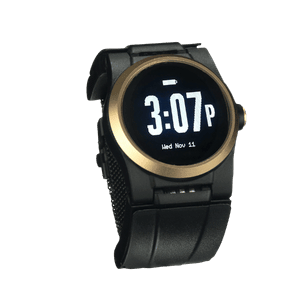
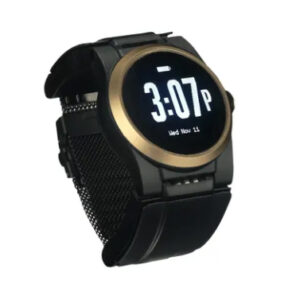
Two Kanega Watches meet that standard with no base station in the picture, because each watch connects through home WiFi and nationwide Verizon cellular service by itself. No shared hub and no single point of failure on a nightstand.
Two differences matter for a couple. RealFall™ was trained on actual falls recorded by Kanega wearers rather than on staged drops by volunteers in a lab, so it recognizes how older adults fall at home. And swappable band batteries mean neither watch comes off to charge, closing the nightly window where one of you sits on a dock while the other sleeps. No fall detection system catches every fall, so two watches narrow the gaps rather than close them.
What two watches change for a household of two
Two watches mean two independent lines into the same US-based, Five Diamond certified monitoring center, open every hour of the day. When one partner is at the store, the one at home is still covered, and the partner who has quietly been doing the caring finally has someone answering for them.
Independence works best when it belongs to both of you, and two devices let each partner keep their own errands and their own confidence walking out the front door. Fall detection is included in the subscription rather than sold as a separate add-on, so there is no additional fall detection fee for the second watch, which is part of why the Kanega Watch suits couples.
If you are weighing one device against two and want a straight answer with no high-pressure sales, call 888-343-1513 or email community@unaliwear.com. Our Care and Safety Experts can walk you through plans, pricing, and whether the Kanega Watch fits your loved one’s routine.
Frequently Asked Questions
How much does a second device add to our monthly cost?
On a shared base station, a second pendant is usually a one-time equipment fee with no added monitoring charge, per Bay Alarm Medical’s June 2026 FAQ. On a watch-based setup, each device carries its own subscription. UnaliWear’s published pricing as of August 2026 is $299 plus $84.95 per month, or $779.40 a year on the annual plan (equivalent to about $64.95 per month). UnaliWear also publishes a discount for couples buying two watches, alongside discounts for AARP members and retired military families, though it does not list the amounts.
One of us barely leaves the house. Do we still need two devices?
Yes, and often the homebound partner needs one most, because the hours they are alone are the hours the other one is out. The useful test is not how far either of you travels, but how many hours a week each of you is the only adult in the house.
What happens if both of us press our buttons at the same time?
With two independently connected devices, each alert opens its own line to the monitoring center. On a shared base station, both buttons report to the same unit and speak through the same speaker, so the two of you would share one conversation with the agent. Ask your provider how it handles a second alert during an open call.
My spouse manages my care. Should the device go to me or to them?
Both of you should have one. The caregiving partner carries real risk, and their fall has a second consequence: the person they care for loses their support at the same moment. If your budget allows only one today, choose the partner least able to reach a phone alone.