Living hundreds of miles from an aging parent changes one thing above all others: how long it takes to find out that something went wrong. Distance rarely creates new hazards. It delays detection, help, and peace of mind.
Some of that worry is guilt, and it deserves one honest sentence before we move on. You have already calculated how fast you could get to their door, and the number was never fast enough. You cannot change the distance, but there are still practical steps you can take to make your parent safer from wherever you are.
Three things matter most when you are not nearby: how quickly a problem is detected, how quickly you hear about it, and who can physically get there. A wearable with automatic detection helps with the first, a shared family communication plan with the second, and a trusted local contact with the third. No app replaces that last person.
Key takeaways
- AARP and the National Alliance for Caregiving found that more than 10 percent of family caregivers live an hour or more from the person they care for.
- Distance mainly delays detection rather than creating new dangers, so automatic alerts matter more here than anywhere else.
- A quarter of family caregivers now use remote monitoring to check on someone from a distance, up from 13 percent in 2020.
- No fall detection system detects every fall, so a remote plan also needs a help button and two-way voice on the same device.
- The National Institute on Aging recommends a shared online contact list and a shared family calendar for long-distance caregiving.
- A local person who can reach your parent within minutes belongs in every remote safety plan.
The Fear of Long-Distance Caregiving
It is usually a Sunday. You call at the time you always call, and it rings out. You text. Nothing. Ten minutes later you try again, then you dig up the number of the neighbor you saved two years ago and never used, and you sit with the phone face up doing arithmetic: six hours by car, or the 6:40 flight tomorrow. Then your mother calls back, cheerful, having been out with the tomatoes. You are relieved, and slightly unsteady for the rest of the day. The title of caregiver for an elderly parent arrives without a job description, and nobody warns you that a large part of it is waiting.
Distance makes that hour heavier for one reason: you cannot check. Someone ten minutes away drives over, sees their mother watering the garden, and the afternoon resets. You get a voice on a phone and have to decide whether it sounds right. Most of the time it does. Occasionally it does not, and you spend the next four hundred miles rehearsing what you will find. We have written before about caring from near or far and the way families carry this quietly. Naming it helps. The underlying problem is information, and information is fixable.
The Safety Gaps That Distance Creates
Most caregiving advice is written for people who live close. In Caregiving in the US 2025, AARP and the National Alliance for Caregiving found that three-quarters of family caregivers live with the person they care for or within 20 minutes of them, with 35 percent in that within-20-minutes group. More than 10 percent live an hour or more away. Caregivers average about 27 hours a week, and the distant group puts those hours in with far worse visibility.
Families also split that work by geography without ever deciding to. The National Institute on Aging notes that the everyday role tends to fall to whoever lives closest. You can hold the medical decisions and the insurance calls without being the primary caregiver for elderly parent routines on the ground, so most of what you know arrives secondhand and late. Broader guidance on caregiver monitoring options covers what families watch for. Each gap below disappears if you live ten minutes away.
- No line of sight on daily function. A phone call tells you how your father sounds. It does not tell you he has started steadying himself on the hallway wall.
- Self-report from a parent who minimizes. When your mother says she is fine, she usually means it. She may also have forgotten Tuesday’s fall.
- Late discovery of a fall. Nobody is in the next room, so time on the floor gets set by whoever happens to call.
- Medication adherence you cannot verify. You can ask about the pill organizer. You cannot look at it.
- A backup contact with no obligation. The neighbor is kind and has a key. She is also entitled to be two counties over on the night you need her.
- Time-zone lag on every alert. A 9 p.m. problem in Phoenix is a midnight call in Boston, and a call you sleep through is a call that did not happen.
The Safety Tools That Help Close Those Gaps
Technology cannot replace being there, and that objection deserves agreement rather than argument. No device sits with your mother in an emergency room. A stack of tools narrows the detection gap, which is the part of the problem distance made worse. In the same AARP and NAC survey, a quarter of family caregivers reported using remote monitoring to check on a care recipient from a distance, close to double the 13 percent recorded in 2020.
An elderly parent caregiver working from another state needs five layers, and only four of them are technology.
- A wearable with automatic fall detection and two-way voice. Automatic detection matters more at a distance than anywhere else, because nobody nearby will notice. Voice turns the alert into a conversation. No system detects every fall, so the device should also carry a help button.
- A way to locate them. GPS-enabled devices show where an alert came from, which matters on a walk or during a moment of confusion. Our guide to GPS location in emergencies covers how that resolves; UnaliCare Locate for families is one on-demand version.
- Medication reminders on the device, not in your calendar. A prompt that reaches your parent where they are beats a text from you.
- One shared family channel. NIA recommends keeping important phone numbers in a shared online document alongside a calendar the whole family can update: doctors, pharmacy, neighbors, appointment dates.
The layer no device replaces
Every remote plan needs one person who can be at your parent’s door in under fifteen minutes. A neighbor, a cousin, a friend from church. Someone a monitoring center can call, and someone who has a way in.
Most long-distance plans are thin right here. Families buy the device, configure the app, and leave the local contact field filled with a name they have not spoken to in a year. Call that person, confirm they still have a key, and ask directly whether they are willing to be listed.
How the Kanega Watch Gives Long-Distance Families Real-Time Peace of Mind
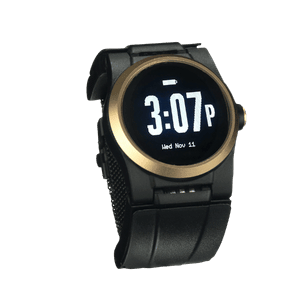
Nothing in this guide makes you present. The Kanega Watch was built for the other half: closing the delay between something happening in your parent’s kitchen and someone qualified knowing about it. Three things make that work across a distance.
RealFall™, trained on real falls
Most fall detection systems are developed using staged falls performed by young and healthy volunteers. RealFall™ was trained on actual falls recorded by real Kanega Watch wearers, helping it recognize how older adults move when they fall. No system catches every fall, which is why the watch also answers a voice command and a button press. That redundancy counts for more at a distance.
A watch that is never removed to charge
Kanega uses swappable band batteries. Your parent swaps a battery rather than docking the watch overnight, so protection does not switch off for eight hours. Overnight is when you are furthest away in every practical sense: asleep, in another time zone, hours from the front door.
A US-based monitoring center, staffed around the clock
When an alert is triggered, it reaches a US-based, Five Diamond certified monitoring center staffed 24/7. An agent speaks to your parent through the watch, judges whether to send EMS, and calls family with the details. An alert chain that only rings family phones cannot do that at 2 a.m. across three time zones.
Your parent is living the way they want to live, in the house they know, and a good safety plan should be quiet enough that they forget it is there. Fall detection works best as an invisible safety net that protects freedom rather than restricting it, four hundred miles away or next door.
If you are building a remote plan and want to think it through out loud, call 888-343-1513 or email community@unaliwear.com. Our Care and Safety Experts can walk you through plans, pricing, and whether the Kanega Watch fits your loved one’s routine.
Frequently Asked Questions
How often should I visit if I live in another state?
There is no correct number, and anyone who hands you one is guessing. NIA’s advice is to make the visits count: talk to your parent ahead of time about what they would like to do, check with the primary caregiver, then decide your top priorities and reserve the rest for a future visit.
What happens if I am asleep in a different time zone when an alert goes out?
This is the strongest argument for a monitored device over an alert chain that only calls family. A monitoring center is staffed around the clock, so an agent speaks to your parent and dispatches help without waiting for you to wake up. Ask any provider what its average answer time is and whether that figure holds overnight.
How do I share the work with a sibling who lives closer to our parent?
Write down who owns what, because resentment grows in the unassigned space. The nearby sibling absorbs the interruptions, so take the tasks that need no presence. NIA lists these among a long-distance caregiver’s real jobs: insurance claims and bill paying, ordering medicines and supplies, arranging in-home care, and researching health conditions and long-term care options.
Can I set up remote safety tools without my parent feeling watched?
Sometimes, and sometimes not. The difference usually comes down to whether they chose the device. Involving your parent in the decision and being specific about what does and does not get shared works better than installing something and announcing it afterward.