If you bought a wearable panic button for elderly parents and it ended up in a drawer, the problem is probably not the feature list. The device your parent keeps wearing is the one that looks like an ordinary accessory, stays comfortable through sleep and everyday use, does not need to come off for charging, and that they had a real say in choosing.
Most families arrive here the same way. You did the research, compared plans, picked something well reviewed, and your mother wore it for a couple of weeks. Then it moved to the dresser, then to the drawer.
She is not being difficult. A pendant worn outside a blouse can make someone feel visibly marked as needing help. If the device does not fit how your parent sees themselves, it is much more likely to go unworn.
One question outweighs the rest: will your parent still be wearing it at two in the morning?
Key takeaways
- An unworn device offers no protection, which makes daily wear a better buying criterion than any feature list.
- In a UK cohort study of people over 90 published in the BMJ, a call alarm was available in 99% of falls where the person fell alone and could not get up, and went unused in 80% of them.
- A 2005 survey of 606 older adults with disabilities found lack of perceived need was the top reason for skipping a personal emergency response system, at 57% of responses.
- A 1995 survey of 106 PERS subscribers found fewer than half wore the button consistently when alone, and wear was lower among those who received it at a family member’s request.
- AARP tells families to ask whether a device draws attention to a loved one’s age or abilities.
Why the Classic Panic Button Has a Style Problem Nobody Talks About
Traditional medical alert pendants are easy to recognize. White plastic, a red button, a cord around the neck: the design language comes from hospital equipment and reads that way across a room. AARP turns this into a question families should ask before buying: is the device unobtrusive enough that your loved one will not feel it draws attention to their age or abilities?
That is why families end up searching for an elderly panic button bracelet instead of another pendant. The instinct is sound. A wrist is where people already wear things by choice, and where others look without drawing
conclusions.
A reasonable objection, not a refusal to be helped
William Mann and colleagues surveyed 606 adults aged 60 and older with disabilities for Assistive Technology in 2005. Only 16% used a personal emergency response system. The most common reason for skipping one was lack of perceived need, given in 57% of responses, ahead of cost (37%) and not knowing about the device (23.7%).
Lack of perceived need does not necessarily mean someone rejects help altogether. It can also reflect discomfort with what the device represents. That is why design and dignity matter alongside safety features. You see it in ordinary moments: a pendant tucked inside a blouse so dinner guests do not notice. Anything built for protecting independence and dignity has to look the part first.
How Device Design Determines Whether It Gets Worn or Gets Left in a Drawer
Styling gets a device accepted in week one. Physical design decides whether it survives to month six. An elderly panic button necklace has its own tactile problems: the lanyard catches a cardigan zip, the pendant swings into the counter edge during dishes, and it has to hang outside clothing to work.
Those frictions add up. Jane Fleming and Carol Brayne, following 110 people aged over 90 in Cambridge, England, for the BMJ in 2008, found a call alarm was available in 99% of falls where the person was alone and unable to get up. In 80% of those falls, they did not use it. One participant explained herself plainly: “I wanted to be able to get up by myself… It makes me annoyed if I have to have help.”

The three moments a device comes off
Many devices come off the body at predictable times. Ask a salesperson what happens at each one.
- At bedtime. A strap that presses or a pendant lying on the collarbone comes off before sleep, and nights are when people get up in the dark.
- On the charger. A device that docks overnight schedules its own gap in coverage, in those same hours.
- In the bathroom. Anything removed to shower gets set on the counter, and that is where it stays.
Wrist devices do not automatically win all three. Some consumer smartwatches still need a nightly charge. Senior products review site AgeTechForYou put two wrist devices through the same questions in a Kanega and Apple Watch comparison we republished.
What Seniors Actually Want to Wear on Their Wrist
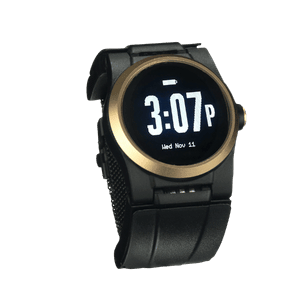
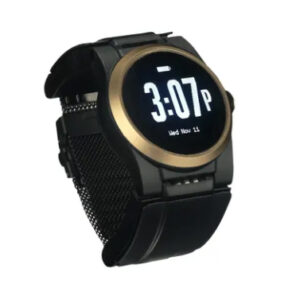
A watch is not a new object to introduce, which is why it sets the bar for everything else. A panic button watch for elderly parents should look like a watch first: a readable face, a band they would have picked out themselves, and no branding that names a medical condition.
None of this is brand specific. Work the checklist below on any product page or sales call, and treat a medical alert watch comparison as the next stop once your shortlist is down to two or three.
- Would they wear this if it only told the time?
- Does it survive handwashing, dishes, and a shower without a nightly decision?
- Can they put it on and take it off alone, with arthritic hands?
- Does the band irritate skin over eight hours of sleep?
- Does anything on it say “medical” to a stranger at the next table?
Let them choose the one they will wear
One important factor is whether the wearer had a say in choosing the device. D. A. Levine and Rein Tideiksaar surveyed 106 personal emergency response system subscribers in the New York City area, average age 83, for the Mount Sinai Journal of Medicine in 1995. Fewer than half wore the help button consistently when alone at home. Wear was more common among people who had obtained the system themselves, and lower among those who got it at a family member’s request. That finding turned on whose decision the device was, not on the hardware.
So hand over the catalogue. Let your parent reject two devices for reasons that sound trivial to you, because those reasons decide whether it stays on. Give them the SOS watch buying questions and let them ask their own.
How the Kanega Watch Delivers Full Protection While Looking Like a Watch You Would Choose Yourself
We built the Kanega Watch around the problem this article describes. It looks like a watch, wears like a watch, and announces nothing to the room.
The battery design exists for the same reason. Kanega uses swappable band batteries, so your parent swaps them for a freshly charged pair without taking the watch off. That matters for daily wear, not just convenience: a nightly charging dock is one of the most reliable ways a device ends up on a nightstand. Behind the watch sits a US-based, Five Diamond certified monitoring center staffed around the clock, and RealFall™ fall detection is included at no add-on fee. No system catches every fall, and no system does anything at all from a drawer.
Your parent gets a device that fits into daily life without making them feel defined by it, and help stays reachable without asking them to advertise anything. That is what a watch you would choose is built to make possible. If you want to talk it through with no high-pressure sales, call 888-343-1513 or email community@unaliwear.com. Our Care & Safety Experts can walk you through plans, pricing, and whether the Kanega Watch fits your loved one’s routine.
Frequently Asked Questions
My parent already has a device they will not wear. What do we do with it?
Check the return window first, and read the refund terms rather than the headline, since restocking fees and return shipping vary. If it has closed, keep the device as a backup. Arguing about the old pendant makes the next one harder to introduce.
How do I raise this without making it a conversation about decline?
Make it about a specific situation instead of about them. Ask what they would want to happen if they slipped in the garden and nobody knew for an hour. A first conversation that goes nowhere is still worth having.
Will they wear it to bed?
Ask what band sizes the provider fits, and give them a measured wrist rather than a guess. Then test one full night inside the return window. If it comes off during the first few nights, that is a sign the fit or comfort may need adjusting.
How long should we test a device before deciding it failed?
Give it a normal month: errands, showers, sleep, a meal out, and days when nobody reminds them. If wear drops off in week two, ask which of the moments above is doing it before you spend anything else.