You have the shortlist. Now you are on the spec page, reading a phrase that repeats on every product and settles nothing: water resistant.
Many medical alert devices sold today are designed to be worn in the shower. The differences appear when you look closer. Some are also designed for brief immersion, while others are not. Some stay on the wrist around the clock, while others have to come off for charging. Those details determine whether your parent is protected during some of the highest-risk moments of the day.
Bathroom injury rates climb steeply with age, and most of those injuries are falls. A device that comes off before a shower protects no one during those minutes, and neither does a watch parked on a nightstand charger at 2 a.m.
Two questions settle most of this before you buy. What does water rating mean for protection, and how many minutes a day does the device spend off your parent’s wrist? Both answers should come directly from the provider.
Key takeaways
- IP ratings come from IEC 60529. The first digit rates solids and dust from 0 to 6, the second water from 0 to 9.
- IPX7 covers immersion in one meter of still water for 30 minutes. IPX8 goes deeper or longer, on conditions the manufacturer must publish.
- Those tests use still water near the device’s own temperature, nothing like a hot, soapy shower.
- Water resistance can diminish over time, so a device’s original rating may not reflect years of everyday use.
- CDC analysis of CPSC injury data estimated 234,094 US emergency department visits for bathroom injuries among people 15 and older in 2008, 81.1% of them falls, with rates rising sharply after 75.
- A device on a charger one hour a day is unavailable about 4% of the year, roughly 15 full days.
Where Most Senior Falls Actually Happen: The Bathroom Stat Every Family Needs to Know
CDC researchers analyzed 2008 data from the injury surveillance sample the Consumer Product Safety Commission operates and estimated 234,094 nonfatal bathroom injuries treated in US emergency departments among people 15 and older. Falls caused 81.1%. The rate climbed hard with age: 112.1 per 100,000 for ages 65 to 74, 241.0 for 75 to 84, and 515.3 for 85 and older, published in MMWR in June 2011.
The same report locates the risk inside the room. Bathing, showering, or getting out of the tub or shower preceded 37.3% of bathroom injuries. Getting in preceded 2.2%. Good shower fall prevention concentrates on the wet exit.
The minutes that carry the weight
Your mother turns off the water, reaches for a towel, and steps over a tub wall onto a wet floor. Her balance is committed before her second foot lands, and the towel bar within reach was never rated to hold a person. The toilet carries its own share: for people 65 and older, standing up from, sitting down on, or using it accounted for 19% to 37% of bathroom injuries.
What home changes leave open
Grab bars inside and outside the tub or shower, grab bars next to the toilet, and nonslip strips are the changes the CDC report puts forward, though it notes more research is needed on how well they work. They belong in any plan for fall prevention at home, alongside a home safety checklist. None of it can call anyone.
Why Devices That Come Off for Charging Miss the Most Dangerous Moments
Work the math before the marketing. A device on a charger one hour a day is off the wearer 365 hours a year, about 4% of the year, roughly 15 full days without coverage. Four percent sounds survivable. The missing hour is never random.
Almost nobody charges at 11 a.m. They typically charge at night, on a nightstand, because that is where the cable lives. The unprotected window tends to land on the overnight bathroom trip, in a dark room, on a hard floor. A family can do everything right and still buy an upside-down schedule.
Two ways the window opens
The first is the dock: the watch goes on at 10 p.m., comes off at midnight, and the bathroom trip happens at 1 a.m. The second is the shower, where a pendant that irritates wet skin lands on the counter and stays there through breakfast. Rated for water, and not on the wrist.

Coverage math you can check at the table
Multiply daily off-wrist minutes by 365 and convert to days. Make the provider commit to a number.
- 1 hour a day on a dock: about 4% of the year, roughly 15 days uncovered
- 2 hours a day, if charging slows as a battery ages: about 8% of the year, roughly 30 days uncovered
Availability and detection are separate questions. No fall detection system detects every fall, and a device on a charger detects nothing. The sensor logic behind that second question gets its own treatment in automatic fall detection explained.
Water Resistance vs. Waterproof: What the Ratings Actually Mean
The IP code comes from IEC 60529. Per the IEC’s own summary, the first numeral rates solid objects from 0 to 6 and the second rates liquids from 0 to 9. An X replaces a digit that was never tested, so IPX7 says nothing about dust. If a waterproof medical alert watch lists IP67, the 6 means dust-tight and the 7 means it passed the immersion test.
Test conditions are where marketing and the standard part company. Applus+ Keystone, an accredited ingress protection laboratory, describes the IPX7 procedure: 30 minutes with the device’s lowest point 1,000 millimeters below the surface, in water held within 5 K of the device’s own temperature. Still water, a fixed depth, a fixed duration. Nothing there resembles a hot shower with soap.
What the tiers cover
| Rating |
What the test covers |
What it leaves out |
| IPX4 |
Splashing from any direction |
Jets, immersion |
| IPX5 |
Water jets from any direction |
Immersion, dust |
| IPX6 |
Powerful water jets |
Immersion, dust |
| IPX7 |
1 meter of still water for 30 minutes |
Dust, jets, hot or soapy water |
| IPX8 |
Immersion beyond IPX7, on conditions the maker publishes |
Anything beyond them |
| IP67 |
Dust-tight, plus the IPX7 test |
Jets, hot or soapy water |
| IP68 |
Dust-tight, plus the maker’s IPX8 conditions |
Anything beyond them |
The water digits are not a single ladder: jets are tested at 5 and 6, immersion at 7 and 8. A device that survived immersion may never have faced a jet.
What “water resistant to 50 meters” means
Consumer devices sometimes use ISO water-resistance ratings instead of IP ratings. Like IP ratings, these are based on standardized laboratory testing rather than everyday conditions. A 50-meter rating does not mean a device is suitable for every water-related activity, and manufacturers often place important limits on how and where the device should be used.
Why a rating fades
Water resistance is not permanent. Over time, seals and gaskets can wear, reducing a device’s resistance to water. Drops, impacts, chemicals, soap, lotions, sunscreen, and repeated exposure to water can all affect how well those seals perform. A water-resistance rating describes a new device under controlled laboratory conditions, not years of everyday use.
How the Kanega Watch Stays on the Wrist 24/7
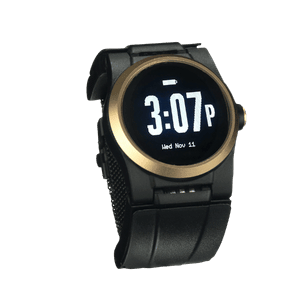
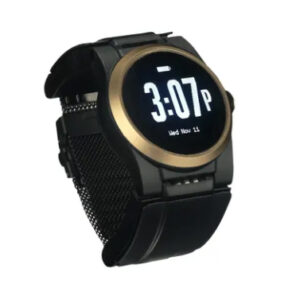
Everything above reduces to one number: hours a day on the body. At UnaliWear we built the Kanega Watch around it. Two swappable batteries are built into the band and run 24 to 36 hours. When they run low, the wearer swaps in a charged pair in seconds while the watch stays on the wrist, a swap designed for limited dexterity. Our oldest wearer is 103. No nightly dock means no uncovered window at 1 a.m.
On water we will be specific, because vague language costs families money. The Kanega Watch is rated IP67. It handles showering, handwashing, dishes, and sweat, and it is not built for full submersion: swimming, water aerobics, and soaking in a bath can damage it, and that damage falls outside our warranty. Described honestly, it is a medical alert watch designed to be worn in the shower, not for swimming or prolonged submersion. Fall detection is RealFall™, trained on real falls from real Kanega wearers rather than on staged drops in a lab. No fall detection system catches every fall, ours included.
A device earns its place by being on the wrist when it is needed, which is why a wearer can wear in the shower and never remove to charge. The best safety plan is the one your loved one can simply keep wearing, without having to remember when to take it off or put it back on.
Bring your spec-sheet questions and we will answer them plainly, with no high-pressure sales. Call 888-343-1513 or email community@unaliwear.com. Our Care and Safety Experts can walk you through plans, pricing, and whether the Kanega Watch fits your loved one’s routine.
Frequently Asked Questions
Can my parent wear a medical alert device in the bathtub or a pool?
It depends on the device. Some medical alert devices are designed to be worn in the shower, while others also support limited submersion. Unless the manufacturer specifically states that bathing or swimming is supported, assume it is not.
Is a higher second digit always the better choice?
Between 7 and 8, yes, since 8 means deeper or longer immersion on conditions the maker sets. Past that, no: a 9 rates hot high-pressure jets, not depth, and an IP67 device may never have faced a jet at all. For bathroom use, certification against both spray and brief immersion beats depth alone.
What should I ask a provider before I buy?
What is the exact IP or ISO rating, in writing? Does it cover the band as well as the case? Is showering specifically listed as supported? Does the warranty cover water damage?
Does dropping the device change its water rating?
It can. Drops and impacts can damage seals that help keep water out, even if there is no visible damage. Ask the manufacturer whether the device should be inspected or replaced after a significant impact.
How should a device be dried after it gets soaked?
Wipe it with a nonabrasive, lint-free cloth and let it air dry. Avoid heat, compressed air, or harsh cleaning products. If the device was exposed to soap, shampoo, sunscreen, or other chemicals, follow the manufacturer’s cleaning instructions before drying it.